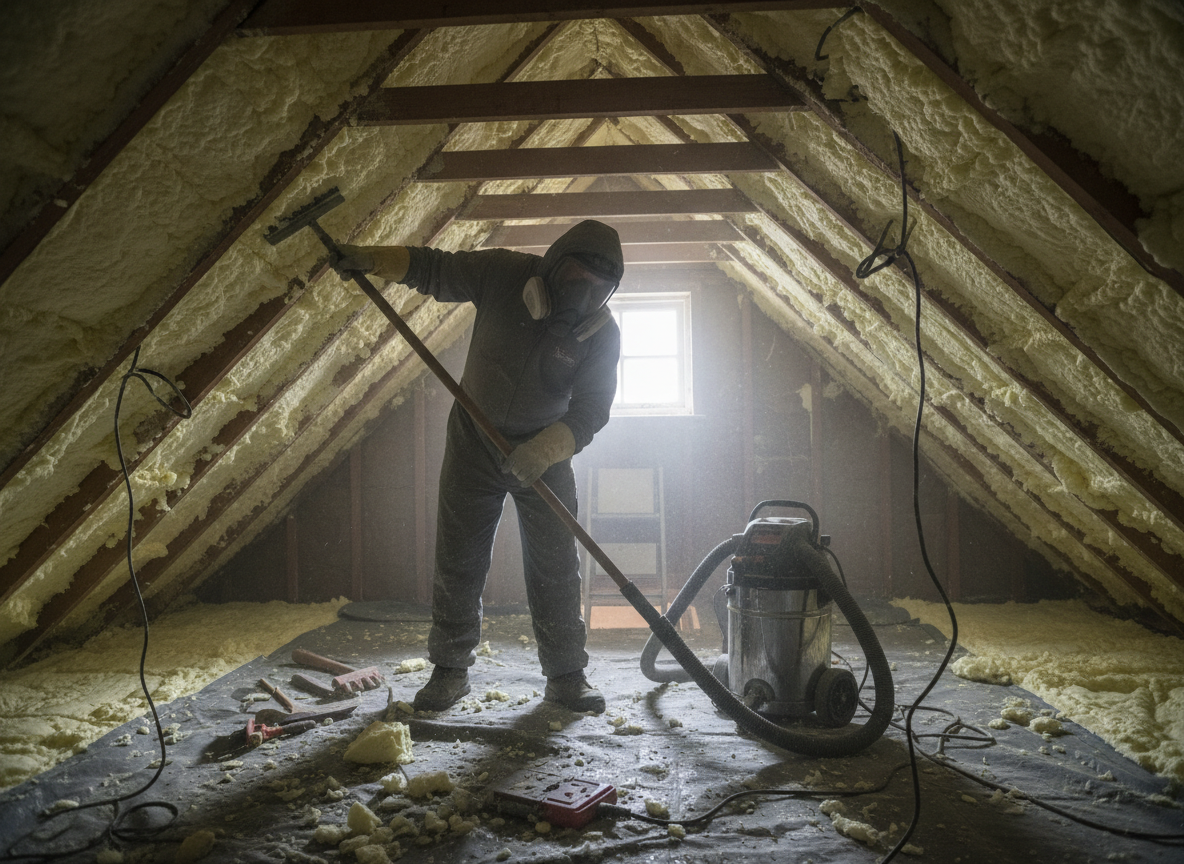
Huddersfield's older terraced and stone-built homes from the Victorian and Edwardian eras frequently received closed-cell spray foam in lofts and wall cavities during the 2000s energy upgrades. Lenders now reject these properties because the foam prevents moisture escape through solid walls and roof voids, leading to hidden rot and failed surveys. Removal requires careful mechanical stripping followed by substrate drying checks to confirm the original fabric can breathe again before a mortgage can proceed.
West Yorkshire winters bring prolonged damp conditions that accelerate timber decay once foam is present. In many HD1 and HD2 postcodes, homeowners discover during remortgage that the foam must be fully extracted down to rafters and joists. Technicians work from 28 Bath Street to reach these jobs quickly, using dust extraction and moisture meters to document every step for the lender's surveyor.
Edge cases include partial foam layers left behind by previous installers that still block ventilation, or foam applied over existing felt that has already failed. Proper removal restores airflow at eaves and ridge while avoiding damage to historic lath and plaster ceilings common in Huddersfield terraces. Lenders typically require photographic evidence of clean, dry timber before releasing funds.
Access constraints in narrow ginnels and shared roof spaces demand smaller equipment and sequenced work to prevent disruption to neighbours. After extraction, properties are left ready for traditional insulation alternatives that satisfy both building regulations and mortgage criteria without trapping moisture.
Technician insight
In Huddersfield, the thing that catches most people out with mortgage lender spray foam removal is how quickly moisture builds up behind the foam in the solid stone walls typical of local terraces once winter temperatures drop and rain persists for weeks.
Terraced House Loft Clearance in HD2
A homeowner in a 1900s stone terrace needed mortgage approval but the survey flagged closed-cell foam throughout the loft. We removed the foam layer by layer down to the rafters, confirmed the timber was dry after extraction, and supplied the required photos and readings. The lender released the funds within two weeks.
How it works
- 1
Initial Survey and Lender Requirements Review
Assess foam type, extent, and any existing moisture damage while confirming the exact documentation the mortgage lender needs.
- 2
Safe Mechanical Removal
Strip foam from rafters, joists and walls using contained extraction to protect the property and surrounding areas.
- 3
Substrate Inspection and Drying
Check timber condition with moisture meters and allow full drying before any new works or lender sign-off.
- 4
Documentation and Handover
Provide dated photos, moisture readings and a clearance statement for the mortgage surveyor.
Pricing
Cost depends on property size, foam depth, and access difficulty in Huddersfield terraces.