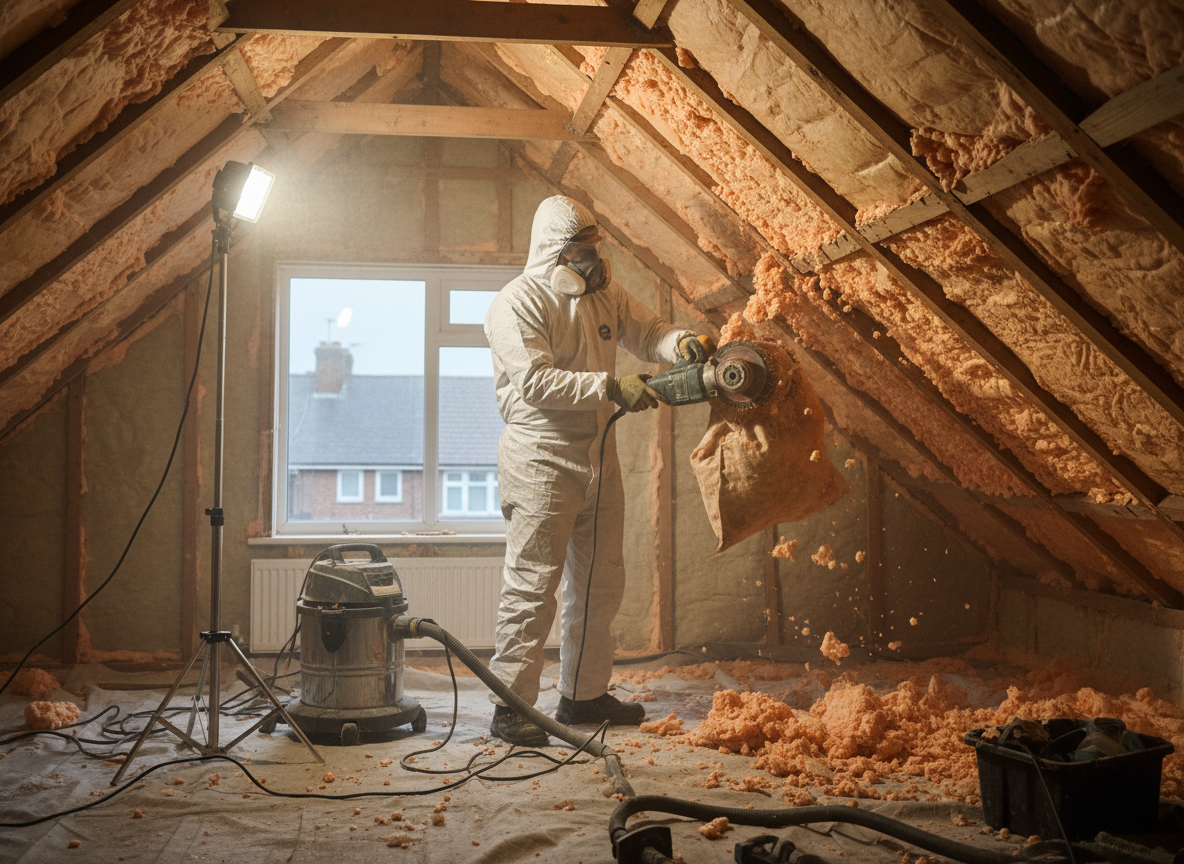
Huddersfield's Victorian and Edwardian terraced houses often feature pitched roofs with limited ventilation, where closed-cell spray foam was applied directly to rafters in the 2000s. Over time this traps moisture from the region's frequent rainfall, leading to timber decay and reduced airflow. Removal requires careful mechanical stripping followed by inspection of joists and underfelt, especially in properties near the Colne Valley where condensation builds quickly during autumn and winter.
Homeowners in areas like Lockwood and Marsh frequently discover foam blocking eaves and ridge vents, worsening damp penetration through stone walls. The process involves protecting internal ceilings below while working from above, then restoring natural ventilation with new soffit vents suited to the narrow loft spaces typical of West Yorkshire terraces. Edge cases include foam bonded to original lath and plaster ceilings, which demands slower hand removal to avoid collapse.
Local building regulations now require breathable insulation upgrades after foam extraction, and many Huddersfield lofts need additional checks for asbestos in older insulation layers. Technicians must account for the hilly terrain that makes scaffold access challenging on rear elevations, extending job times compared to flatter sites. Proper disposal of foam waste follows Environment Agency guidelines for the area.
Seasonal timing matters here: spring and early summer offer drier conditions for roof work, reducing risk of water ingress during the removal phase when the loft is temporarily exposed.
Technician insight
In Huddersfield, the thing that catches most people out with loft spray foam removal is how the steep roof pitches and narrow eaves on pre-1919 terraces trap moisture once the foam is in place, especially with the constant Yorkshire rain driving water under the tiles.
Lockwood Terrace Loft Clearance
Homeowners in a Lockwood terraced house noticed persistent damp patches after years of closed-cell foam in the loft. Inspection revealed blocked eaves and early rot on rafters from trapped condensation. We stripped the foam mechanically, restored ventilation with new soffit vents suited to the narrow space, and cleared debris without disturbing the original ceiling below. The loft now breathes properly and the damp issue has stopped.
How it works
- 1
Initial Loft Inspection
Assess foam type, thickness, and condition while checking for damp, rot, and blocked vents in Huddersfield properties.
- 2
Safe Removal Setup
Protect ceilings and floors, then use mechanical and manual methods to strip foam without damaging rafters or original features.
- 3
Ventilation Restoration
Clear eaves and install appropriate vents to suit the pitched roofs common in West Yorkshire terraces.
- 4
Final Clearance and Advice
Remove all debris, inspect for hidden issues, and provide guidance on next insulation steps compliant with local standards.
Pricing
Costs depend on loft size, foam depth, and access difficulty in older Huddersfield homes; we provide upfront quotes after inspection.