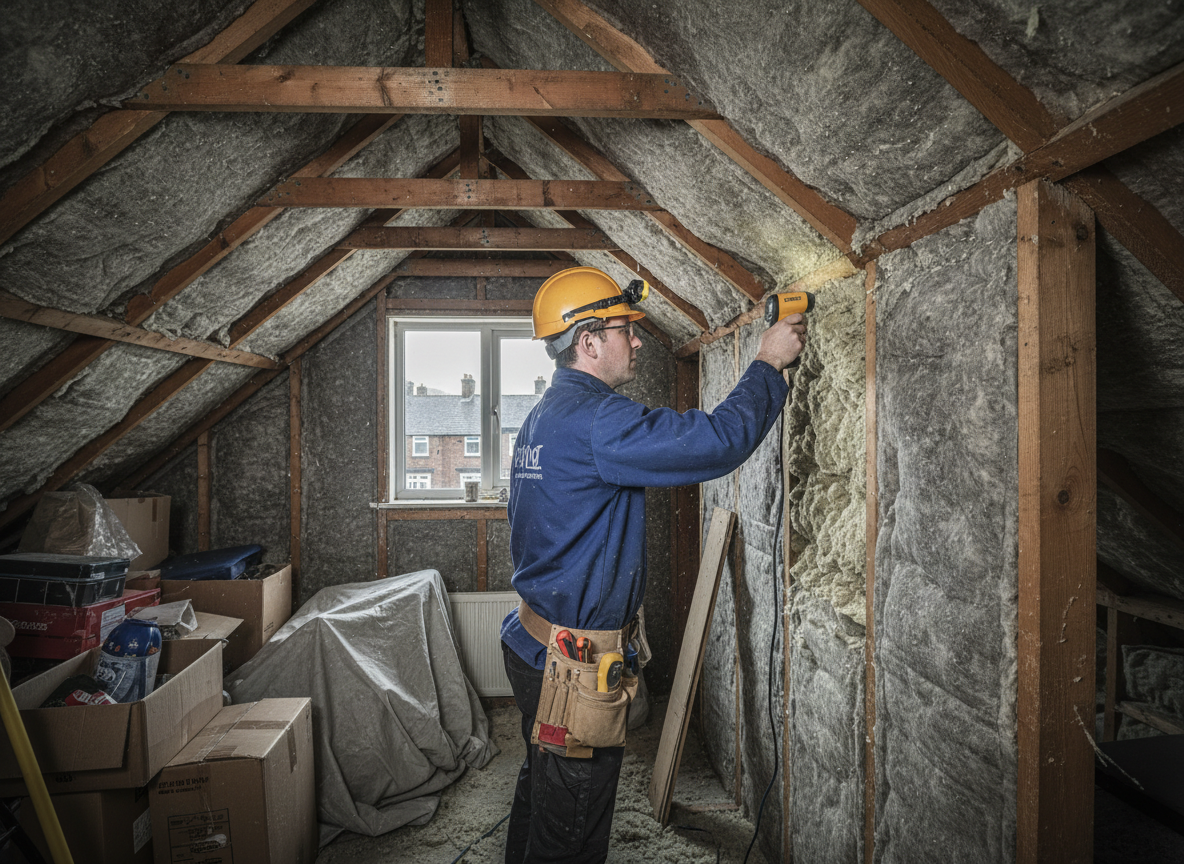
Huddersfield's Victorian and Edwardian terraced houses and stone-built semis often received spray foam insulation in lofts and under roof decks during the 2000s. Over time the closed-cell material traps moisture against timber joists and Yorkshire stone, especially where original slate roofs meet the frequent heavy rainfall and driving winds common across West Yorkshire. An insulation assessment starts with moisture meter readings on rafters, checks for ventilation gaps blocked by foam, and looks for signs of rot or mould that only appear once the foam is disturbed.
Assessment also covers the specific risks in properties near the Colne Valley or on the steeper slopes around Lindley and Marsh. Here, poor drainage and high water tables can push damp upward into ground-floor insulation retrofits. We examine cavity walls for foam that has bridged the damp-proof course and test airflow in roof voids that lack the ridge vents common in newer builds. These details determine whether full removal is needed or whether targeted extraction and drying can salvage the structure.
Homeowners in Huddersfield frequently discover that building control records from the original foam installation are missing, leaving uncertainty about fire performance and load-bearing changes. Our assessment includes a visual and thermal inspection of party walls shared with neighbouring terraces, where foam can migrate and affect multiple properties. We document every finding with photos and moisture logs so owners can see exactly which areas require attention before any removal work begins.
Technician insight
In Huddersfield the thing that catches most people out with insulation assessment is how often spray foam was pumped straight onto unventilated stone roofs in the terraces around Paddock and Newsome. Once winter temperatures drop and the rain sets in, that foam holds every drop against the timbers and the rot starts from the inside out.
Lindley Terrace Loft Assessment
A homeowner in Lindley called after noticing musty smells in the bedrooms below the loft. We found closed-cell foam covering the entire underside of the slate roof with no ridge ventilation. Moisture readings on the rafters reached 28 percent in several bays. We documented the blocked eaves and produced a removal plan that included temporary drying before extraction.
How it works
- 1
Initial Site Visit
We arrive at the Huddersfield property and review loft and wall access points while noting the age and construction type of the stone or brickwork.
- 2
Moisture and Thermal Survey
Readings are taken across joists, rafters and any foam-covered surfaces to map damp pockets created by the region's wet climate.
- 3
Ventilation and Structural Check
We inspect for blocked air bricks, missing ridge vents and any timber degradation typical in older West Yorkshire homes.
- 4
Written Findings Report
A clear report outlines affected areas, risks of leaving the foam in place, and the practical steps needed for safe removal.
Pricing
Cost depends on property size, number of floors and ease of loft access; we provide a clear quote after the assessment visit.